

When an urge hits, it can feel like there are only two options: give in, or grit your teeth and fight. There’s a third one, and it works better than both. It’s called urge surfing.
Why fighting an urge backfires
Most of us were taught to resist. Push it down, hold it together, wait it out. Reuben Lowe, the ACT therapist who teaches Mastering Urges in the VandrMen app, calls this white-knuckling. His point is blunt: resistance doesn’t dissolve an urge, it amplifies it. The harder you fight, the more of your attention the urge gets.
He borrows a line from Carl Jung to sum it up: what you resist persists.
Think of it as a wave
Psychiatrist Dr Steven Chau explains it the same way in Man Answers. Cravings are like waves. They come and they go. What traps people is the belief that this is how they’re going to feel forever. It isn’t. An urge rises, peaks and falls.

How to surf an urge
You don’t need to stop the wave. You need to stay with yourself while it moves. Here’s how.
-
Notice it.
Say it plainly: I’m noticing an urge. Where is it in your body? Your chest, your stomach? Naming it creates a gap between the urge and what you do next.
-
Drop the fight.
Don’t push it away and don’t feed it. Breathe, and let it be there. You’re watching the wave, not wrestling it.
-
Buy yourself time.
Dr Chau’s advice is to do five or ten minutes of something else, then another five or ten. Each block of time lets the wave move a little further through.
-
Choose your next move.
Pick one small action that points you towards the life you want. Reuben calls this a towards move.
It isn’t always an urge
Reuben makes a point that often goes unsaid. Not every slip starts with a strong craving. Sometimes it’s habit: you open your phone and end up on the same sites without thinking, like muscle memory. Sometimes it’s a thought: just once won’t hurt. Knowing which one you’re dealing with, an urge, a habit or a thought, makes it easier to catch.
When you need help in the moment
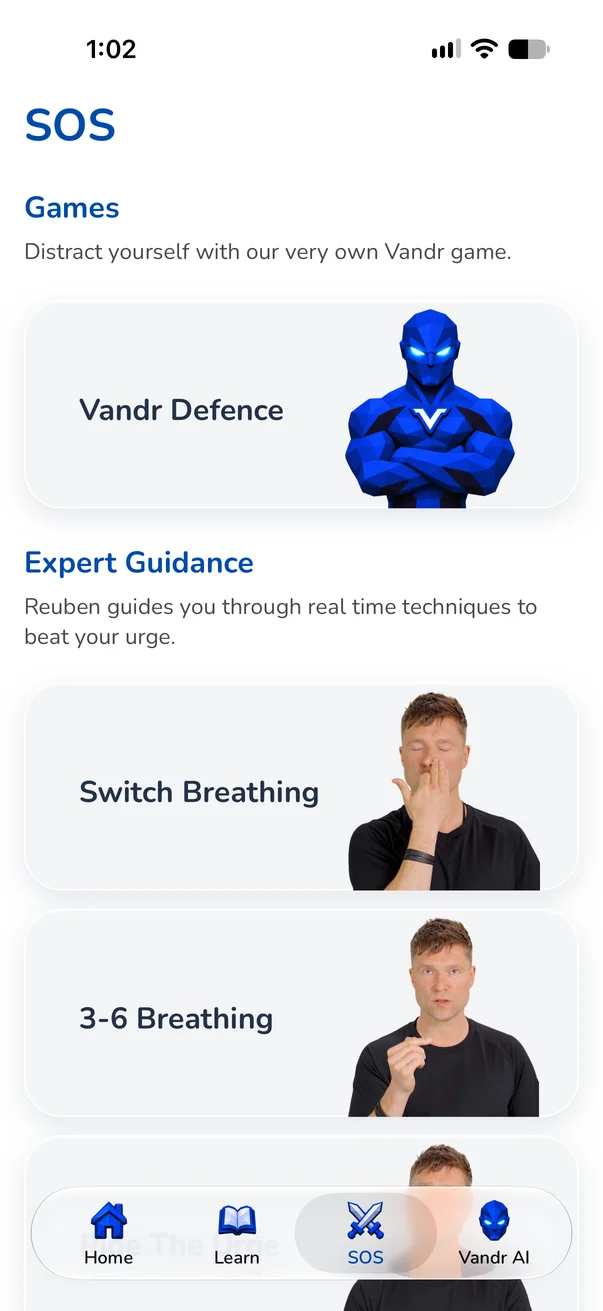
That’s what the SOS tab is for. Open it instead of porn and Reuben guides you through it on screen: Switch Breathing, 3-6 Breathing, Ride The Urge or Regain Control. Each one takes about three minutes.
One wave at a time
Every time you let an urge rise and fall without acting on it, you’re practising. It gets less threatening each time. As Reuben puts it, this is how change happens: one wave at a time, one urge at a time.
This article is general information from the VandrMen courses. It isn't medical advice and doesn't replace a doctor, psychologist or therapist.